How Does a Tandem Lamination Machine Apply Two Coats?
Table of Contents
You're producing a coated paper or a flexible laminate, and the specification calls for two functional layers — a tie layer and a barrier layer, or a primer and a topcoat — applied without stopping the web between passes. A Lamination Machine in the tandem configuration mounts two extrusion stations in line, so the substrate receives both coatings in a single continuous run. The GIII series from Longge runs this architecture on paper, non-woven, and woven substrates at coating speeds of 180–240m/min across a 600–1200mm coating width. This article explains how the two stations work together, what the tandem layout changes about production flow, and what to verify when you're specifying a dual-station line for high-GSM paper or flexible packaging.
What Does “Tandem” Actually Mean in Extrusion Lamination?
Two Extrusion Stations, One Web Path
In a single-station extrusion lamination line, the substrate unwinds, passes one extruder die, receives one molten resin layer, is cooled and nipped, and rewinds. If a second layer is needed, the roll comes off and goes through the line again — or through a separate line.
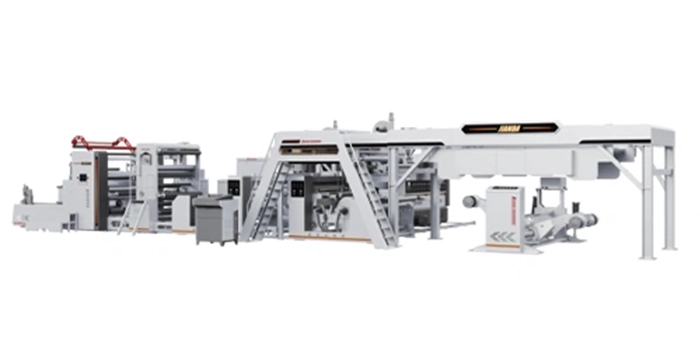
A tandem line mounts a second extruder and die downstream of the first. The web passes the first die, receives the first coating, then continues to the second die for the second coating before cooling and rewinding. The two layers are applied in one pass, with one unwind and one rewind. The GIII tandem configuration is built around this two-station flow, with the main motors rated 55kW × 2 and a total connected power of approximately 260kW .
Why One Pass Matters for Heat-Sensitive Substrates
Every additional pass through an extrusion line exposes the substrate to heat, tension, and handling. Paper and non-woven substrates pick up moisture or lose dimensional stability when they run through a line twice. A tandem line reduces that exposure to a single pass, which is why it's used for high-GSM paper (65–450 g/m²) and for substrates that can't tolerate repeated thermal cycles .
How Do the Two Stations Work Together?
Sequential Coating Without Intermediate Rewinding
The first station applies the base coating — often a tie layer or a primer that promotes adhesion. The web then travels to the second station, where the top coating is applied. Between the stations, the first coating is still molten or semi-molten, so the second layer bonds to it directly. That wet-on-wet contact is what creates a continuous, delamination-resistant bond between the two resin layers.
The line's design line speed is 270m/min, with the coating speed running 180–240m/min depending on the material and process technique . The 270m/min design ceiling gives the line headroom to run at the coating speed without pushing the drives to their limit.
What the Dual Drive Delivers
The 55kW × 2 main motor configuration gives each extruder its own drive, so the two stations can run at different screw speeds and output rates. That independence matters when the two layers have different target thicknesses or when the two resins have different melt viscosities. The maximum extrusion output is listed at 370kg/h, which supports the coating weights used in high-GSM paper lamination .
| Parameter | GIII Tandem Extrusion Lamination Machine |
|---|---|
| Coating width | 600–1200mm |
| Substrate range | High-GSM paper (65–450g/m²), non-woven, woven |
| Design line speed | 270m/min |
| Coating speed | 180–240m/min (material-dependent) |
| Main motor | 55kW × 2 |
| Total power | ≈260kW |
| Max. extrusion output | 370kg/h |
| Unwind diameter | ≤Φ1500mm |
| Rewind diameter | ≤Φ1600mm |
| Power supply | 380V / 3-phase / 50Hz |
What Substrates and Products Run on a Tandem Line?
High-GSM Paper, Non-Woven, and Woven Materials
The GIII line is specified for high-GSM paper (65–450g/m²) as well as non-woven and woven substrates . High-GSM paper is used in packaging that needs stiffness and barrier performance — food cartons, industrial wrapping, and release papers. Non-woven and woven substrates are used in hygiene products, medical packaging, and technical textiles where a coated surface adds barrier or printability.
The 600–1200mm coating width covers the web widths used in these applications. The line handles LDPE, PP, and other coating-grade resins, so the material selection follows the product's barrier and seal requirements rather than the machine's limitations.
Where Dual-Layer Coatings Are Required
Dual-layer coatings appear where a single resin can't deliver both adhesion and barrier. A tie layer bonds to the paper or film; a barrier layer provides moisture or grease resistance. In flexible packaging, a tandem line can apply a primer and a heat-seal layer in one pass. In release paper production, the two stations can build a base coat and a release coat without an intermediate rewind. A Lamination Machine with tandem architecture like the GIII from Longge is built for these multi-layer specifications, where the second layer has to bond to the first without delamination.
What Should You Check Before Specifying a Tandem Line?
How do I match the coating width to my substrate?
The GIII covers 600–1200mm. Measure your widest and narrowest substrate rolls against that range. Running at the extreme edge of the width range leaves little margin for edge trim and web guiding. If your production mix includes widths near the top of the range, confirm that the line's tension control and cooling capacity are adequate for the full width.
What's the difference between design speed and coating speed?
The design line speed is 270m/min, but the actual coating speed depends on the substrate, the resin, and the coating weight. The quoted coating speed range is 180–240m/min . Use the coating speed range for production planning, and treat the design speed as the mechanical ceiling that the drives and web handling can support.
What maintenance does the tandem line need?
Clean both die lips regularly to prevent carbon buildup that causes streaks in the coating. Check the web path between the two stations for tension stability — a tension disturbance between stations shows up as thickness variation in the second layer. Inspect the cooling rollers for surface damage and verify the nip pressure on both stations. The dual extruders have separate screens and filters, so plan the maintenance schedule for both.
Straight Answers on Tandem Extrusion Coating
Can a tandem line run a single layer if needed?
Yes. Running only the first station and leaving the second station idle allows the line to produce single-layer coatings. The second extruder can be kept at temperature or shut down, depending on the resin and the expected restart time. That flexibility means the line can cover both single-layer and dual-layer production without a separate machine.
What causes interlayer delamination on a tandem line?
Delamination between the two extrusion layers usually comes from insufficient interfacial temperature or incompatible resins. The first layer has to be hot enough when the second layer lands on it to create a bond. If the web cools too much between stations, the second layer sits on a solid surface instead of fusing. Check the inter-station distance, the web temperature, and the compatibility of the two resin grades.
What substrates can't run on a tandem line?
Substrates that are too heat-sensitive or too weak to survive two die contacts in one pass may not be suitable. Very thin films can stretch or distort under the combined tension and heat of two stations. Very open non-wovens may let the first coating strike through before the second station is reached. Test the actual substrate on the line before committing to a production specification.
What's the power requirement for the GIII?
The total connected power is approximately 260kW, with two 55kW main motors . The supply is 380V, 3-phase, 50Hz . Confirm the facility's electrical capacity for the combined load, including the starting current of both extruders.
Let's Match a Tandem Lamination Line to Your Coating Spec
Share Your Substrate and Layer Requirements
A Lamination Machine in the tandem configuration should match your substrate width, layer functions, and target coating speed — not the other way around. The GIII Full Automatic Tandem Extrusion Lamination Machine from Longge applies two extrusion layers in one pass across a 600–1200mm coating width, handles high-GSM paper (65–450g/m²) and non-woven/woven substrates, and runs at coating speeds of 180–240m/min with 55kW × 2 main motors. If you're specifying a dual-station line for multi-layer paper coating or flexible lamination, send us your substrate and layer requirements — we'll help you confirm the right configuration before you order.