Can a Slitting Machine Slit and Sheet in One Pass?
Table of Contents
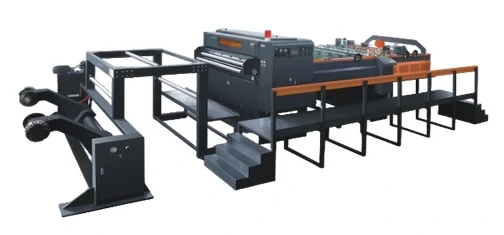
Yes. A Slitting Machine configured for reel-to-sheet conversion can simultaneously slit the web longitudinally and cut it transversely into sheets. The ZNCM series from Longge combines a mid-slitting station, a rotary knife cutting unit, and an automatic stacker into one continuous line, running at up to 350 cuts per minute with ±0.1mm length accuracy. This article explains how the slitting and sheeting functions work together, what the servo drive contributes to length consistency, and what to verify when you're matching a converter to your production floor.
How Do Slitting and Sheeting Work Together?
The Mid-Slitting Station
Before the web reaches the cutting knife, it passes through the mid-slitting station. Circular blades divide the wide parent web into narrower strips, and a waste collection system removes the trimmed edges. That longitudinal cut happens continuously as the web moves, so the slitting process doesn't interrupt the flow toward the transverse cutter.
The value of doing this inline is that a converter can take a 1950mm parent roll and produce 1450mm sheets without a separate offline slitting step. The waste edges are pulled away automatically, so the operator isn't managing loose trim while the line runs.
The Rotary Knife Cut
After slitting, the web enters the rotary cutting station. The upper blade rotates on a cylinder and shears the paper against a fixed lower blade. The cutting length is controlled by the ratio of the web speed to the knife rotational speed. The servo drive manages that ratio, so the cut length stays accurate as the roll diameter changes.
Because the cut is a shear action against a fixed anvil, the edge stays clean without the dust or deformation that a guillotine chop can cause. The combination of the longitudinal slit and the transverse cut means the finished stack contains sheets of the exact width and length the downstream process requires.
| Parameter | ZNCM-1450 | ZNCM-1750 | ZNCM-1950 |
|---|---|---|---|
| Cutting length range | 450–1500mm | 450–1650mm | 450–1650mm |
| Paper weight | 50–550g | 50–550g | 50–550g |
| Max. roll diameter | 1800mm | 1800mm | 1800mm |
| Max. web width | 1450mm | 1750mm | 1950mm |
| Cutting speed | 350 cuts/min | 350 cuts/min | 350 cuts/min |
| Cutting accuracy | ±0.1mm | ±0.1mm | ±0.1mm |
| Max. stack height | 1600mm | 1600mm | 1600mm |
What Does the Servo Drive Contribute to Length Accuracy?
Closed-Loop Control and Roll Diameter Compensation
The servo system closes the loop between the web feed and the knife rotation. As the unwind roll diameter shrinks, the surface speed changes if the rotational speed stays constant. The servo compensates by adjusting the feed rate, so the cut length stays consistent from the start of the roll to the end.
Without that compensation, the first sheets off a full roll would be one length, and the last sheets off an empty roll would be another. The ±0.1mm cutting accuracy holds across the full roll diameter range, which means the sheets stay within tolerance regardless of where they sit in the production run.
Web Tension and Static Control
The ZNCM includes automatic tension regulation and static neutralization. Tension control keeps the web flat and stable as it enters the cutting station—a slack web wanders and produces length variation; an over-tensioned web stretches and changes the cut length. Static elimination prevents the sheets from clinging to each other or to the machine surfaces after cutting, which is critical for thin stocks and for stacking consistency.
How Does the Machine Handle the Finished Sheets?
Jogging and Stacking
The automatic sheet jogging and stacking system collects the cut sheets into neat piles. The maximum stack height is 1600mm, and the stacker includes front and side joggers that align the sheets as they accumulate. The electric chain-style stacker lowers the pile as it grows, so the sheets drop a consistent distance instead of falling onto a tall stack.
Automatic Counting and Label Insertion
The ZNCM includes an automatic counting and label insertion system. The operator sets the sheet count per stack on the HMI, and the machine inserts a label at the set interval. That function eliminates manual counting and marking, which reduces labor and the risk of miscounts in the finished stack.
A Slitting Machine configured for reel-to-sheet conversion like the ZNCM series from Longge combines the mid-slitting function, the rotary cutting station, and the counting system in one platform. The machine handles paper, film, and cardboard rolls across the 50–550g weight range.
Where Does Reel-to-Sheet Converting Fit in Production?
Printing, Packaging, and Cardboard Conversion
The ZNCM is used in professional printing, packaging, and paper converting operations. Printing houses convert jumbo rolls into press-ready sheets. Packaging converters produce sheet stock for folding cartons, corrugated board liners, and food packaging. Cardboard converters sheet heavy stocks for box-making lines.
The 450–1650mm cutting length range covers the sheet sizes used in these applications, and the 1450–1950mm web width range matches the parent roll sizes from paper mills. The machine's ability to run different paper weights without mechanical changeover makes it a flexible asset for a converting floor that handles mixed orders.
What Should You Check Before Selecting a Sheeter?
How do I match the web width to my rolls?
Check the maximum web width against your widest parent roll. The ZNCM-1450 handles 1450mm, the ZNCM-1750 handles 1750mm, and the ZNCM-1950 handles 1950mm. Running a roll wider than the machine's capacity isn't possible, and running a roll that's close to the limit leaves no margin for edge trim. Choose the model that covers your roll width with working room.
What paper weight does the machine handle?
The standard range is 50–550g. Lighter stocks in the 50–100g range are used for newsprint and lightweight packaging. Heavier stocks up to 550g are used for cardstock and rigid packaging. Confirm your specific grade against the machine's range, and test the material if it sits near the upper limit.
What air pressure and power are required?
The machine requires 0.8MPa air pressure and runs on 380V/220V, 50Hz power. Check the facility's compressed air supply and electrical capacity against these requirements. A pressure drop during the cutting cycle can affect the knife actuation and the sheet transfer.
What maintenance does the rotary knife need?
Inspect the upper and lower blades for wear and nicks. A dull rotary knife produces a rough cut edge and requires more cutting force, which increases the load on the drive system. Check the shear gap between the upper and lower blades and adjust it according to the paper weight. Clean the static elimination bars and the web path to prevent dust buildup.
Straight Answers on Reel-to-Sheet Converting
What's the difference between a sheeter and a slitter-rewinder?
A slitter-rewinder cuts the web longitudinally and rewinds it into narrower rolls. A sheeter cuts the web transversely into flat sheets. The ZNCM combines both functions—it can slit the web to width and then cut it to length, delivering flat sheets rather than narrow rolls.
Can the machine run different sheet lengths without stopping?
The cutting length is set through the HMI, and the servo system adjusts the knife timing and web feed to match. Changing the length is a control parameter change, not a mechanical change. The machine can switch between lengths between production runs, but a continuous change during a run would require the servo system to re-synchronize.
What causes the cut length to drift?
Length drift usually comes from web tension variation or servo synchronization error. If the unwind tension changes as the roll diameter decreases, the web surface speed changes and the cut length shifts. The automatic tension control and the servo compensation address that. If drift persists, check the tension controller calibration and the servo feedback signal.
What's the maximum cutting speed?
The ZNCM series reaches 350 cuts per minute or 350 meters per minute, depending on the cut length. At shorter cut lengths, the cuts-per-minute rate governs; at longer lengths, the meter-per-minute rate governs. The actual production speed depends on the paper weight, the cut length, and the operator's handling of the stack changes.
Let's Match a Sheeter to Your Converting Line
Share Your Roll Width and Sheet Requirements
A Slitting Machine in the reel-to-sheet configuration should match your parent roll width, sheet length, and paper weight—not the other way around. The ZNCM High-Speed Reel-to-Sheet Cutter from Longge runs at 350 cuts/min with ±0.1mm accuracy, handles web widths from 1450mm to 1950mm, and cuts sheets from 450mm to 1650mm on 50–550g paper. The rotary top knife and fixed bottom knife, servo-driven length control, mid-slitting and waste collection, and automatic counting and stacking make it a complete converting station. If you're specifying a sheeter for printing, packaging, or cardboard conversion, send us your roll width and sheet requirements — we'll help you confirm the right model before you order.