What Does an EPE Foam Lamination Line Add to Foam?
Table of Contents
Specialized Film Processing Equipment for EPE foam does one specific job: it takes a foam sheet or roll and adds a thin extruded film layer to its surface. That layer changes what the foam can do—it can carry print, provide a barrier, or give the surface a different appearance and feel. You'll see what the added layer contributes, how the extrusion and lamination steps work together, and where the three model sizes sit.
What Questions Come Up Before Laminating EPE Foam?
What does the extruded layer add that the foam doesn't have?
EPE foam is a closed-cell polyethylene structure, and its surface isn't suited to printing or to a direct coating. An extruded LDPE or PP layer gives the foam a smooth, continuous skin that accepts print and provides a barrier. The page lists the main unwinder material as EPE, fabric, or paper, and the second unwinder material as film or foil. The extruded layer is the new surface—the foam provides the cushioning and the film provides the printable, sealable, or barrier face.
What thickness range does the added layer cover?
The page lists the lamination thickness as 0.01–0.10 mm. That range spans a very thin sealable skin through a heavier protective layer. The thin end suits a print-receptive surface; the thick end provides more barrier and more mechanical protection. The usable resins are LDPE and PP, both coating-grade materials that melt and flow through the extruder die.
The Extrusion and Lamination Sequence
The line has three roll positions: the main unwinder, the second unwinder, and the winder. The main unwinder carries the EPE foam at a diameter up to Φ1200mm; the second unwinder carries film or foil at up to Φ500mm; and the winder collects the finished laminate at up to Φ1200mm.
The extruder sits between the unwinders and the winder. Resin is melted and extruded as a thin film, which meets the foam at the lamination nip. The second unwinder can feed a film or foil into the same nip, so the finished product can be a two-layer or three-layer structure depending on what's loaded.
| Parameter | JDLM600/60 | JDLM1300/80 | JDLM1700/90 |
|---|---|---|---|
| Screw diameter | Φ60 mm | Φ80 mm | Φ90 mm |
| Finished film width | 200–400 mm | 600–1200 mm | 900–1600 mm |
| Lamination thickness | 0.01–0.10 mm | 0.01–0.10 mm | 0.01–0.10 mm |
| Main unwinder material | EPE, fabric, paper | EPE, fabric, paper | EPE, fabric, paper |
| Second unwinder material | Film, foil | Film, foil | Film, foil |
| Usable resin | LDPE, PP | LDPE, PP | LDPE, PP |
| Design line speed | 40 m/min | 40 m/min | 40 m/min |
| Max. extrusion capacity | 60 kg/h | 120 kg/h | 140 kg/h |
| Main motor power | 11 kW | 22.5 kW | 30 kW |
| Total power | 40 kW | 100 kW | 130 kW |
| Power supply | 380V / 3 phase / 50Hz | same | same |
Why the screw diameter steps with the film width
The 60mm, 80mm, and 90mm screw diameters correspond to the 200–400mm, 600–1200mm, and 900–1600mm film widths. A wider film needs more extruded resin per meter of web to maintain the same coating thickness, and a larger screw delivers that higher output. The extrusion capacity figures—60, 120, and 140 kg/h—are the throughput that matches each width.
The Nip, the Substrate, and the Bond
The lamination nip is where the molten film meets the substrate. The extruded film has to arrive at the nip at the right temperature and the right thickness, and the nip pressure has to be uniform across the web width so the bond is consistent from edge to edge.
The main unwinder is listed for EPE, fabric, or paper—three different substrate types with different surface characteristics. EPE is a closed-cell foam, fabric is a woven or non-woven textile, and paper is a fibrous sheet. The extruded LDPE or PP layer bonds mechanically to each of those surfaces, and the nip pressure has to be set for the substrate rather than a single default.
-
Main unwinder: EPE, fabric, or paper, up to Φ1200mm
-
Second unwinder: film or foil, up to Φ500mm
-
Resin: LDPE or PP, coating grade
-
Lamination thickness: 0.01–0.10 mm
-
Line speed: 40 m/min design speed
-
Power supply: 380V, three phase, 50Hz
Why the second unwinder matters for a three-layer structure
The second unwinder lets a film or foil be fed into the nip alongside the extruded layer. That turns the line from a two-layer process (foam plus extruded film) into a three-layer process (foam plus extruded film plus film or foil). For a product that needs a barrier on one side and a print surface on the other, or a foil facing on a foam substrate, the second unwinder provides the additional layer without a separate lamination pass.
The Three Models and the Width Envelope
The three JDLM models cover different production widths. The JDLM600/60 handles 200–400mm finished film width, the JDLM1300/80 covers 600–1200mm, and the JDLM1700/90 reaches 900–1600mm. The overlap between the 1300 and 1700 models means a converter working at 900–1200mm can choose either model depending on the expected growth in width.
The total power steps from 40kW on the JDLM600/60 to 100kW on the JDLM1300/80 and 130kW on the JDLM1700/90. Those figures cover the extruder motor, the heating zones, the unwinders, the winder, and the control system. The main motor power figures—11kW, 22.5kW, and 30kW—are the extruder drive, which is the load that scales most directly with the screw diameter and the output requirement.
What the 40 m/min design speed means for output
The design line speed is 40 m/min across all three models. At that speed, the output in square meters per hour is the line speed multiplied by the finished width. The JDLM600/60 at 400mm width and 40 m/min produces far less area per hour than the JDLM1700/90 at 1600mm width and the same speed. The model choice is driven by the width the product requires, not by a difference in line speed.
Where the JDLM Line Fits a Foam Converter's Floor
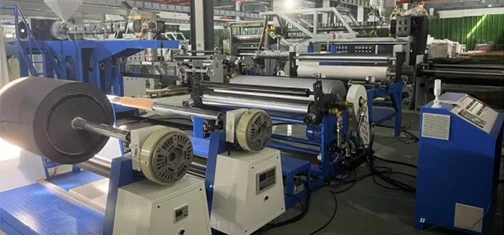
The Specialized Film Processing Equipment JDLM series from Longge Global is built around the extrusion lamination process the page describes: a main unwinder for EPE, fabric, or paper, a second unwinder for film or foil, an extruder running LDPE or PP, and a lamination nip that bonds the layers at 40 m/min. The three models cover 200–400mm, 600–1200mm, and 900–1600mm finished widths, with 0.01–0.10mm lamination thickness and 60–140 kg/h extrusion capacity. For an EPE foam converter producing packaging, protective, or construction foam with a film skin, the value sits in the single-pass process—the foam and the extruded layer are bonded in one run, and the second unwinder can add a third layer without a separate lamination step.
What to confirm before matching a product to the JDLM line
Confirm the finished width against the 200–400mm, 600–1200mm, or 900–1600mm model envelope, the lamination thickness against the 0.01–0.10mm range, and the substrate against the EPE, fabric, or paper list. Check the resin against the LDPE or PP coating grades, and the second unwinder material against the film or foil requirement. The page's specifications give the starting point; the actual product structure determines which model and which roll configuration fit.
Let's Match a Foam Structure to the JDLM Line
Send over your finished width, lamination thickness, substrate type, and whether a second film or foil layer is needed—we'll help you check them against the 200–1600mm width range, the 0.01–0.10mm thickness envelope, and the LDPE/PP resin options. Talk to Longge Global about your Specialized Film Processing Equipment requirements and get a line-level answer before you commit to the equipment.