How Do Reflective Foil and Foam Work Together?
Table of Contents
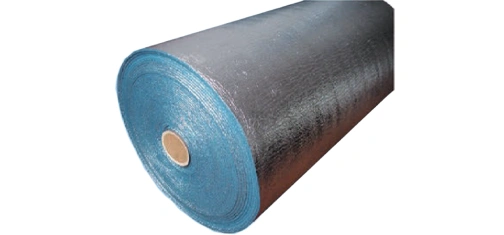
Film Materials in the insulation category do two different jobs at once: the foil face handles radiant heat, and the foam core handles the air movement behind it. You'll see how those two mechanisms combine in one roll, what the fire-retardant and antiglare treatments add, and how the structure is specified.
What Does Each Layer Actually Do?
Why reflect radiant heat instead of absorbing it?
Radiant heat travels through air without heating it, and it only becomes sensible heat when it strikes a surface. An aluminum foil face reflects that radiation back toward its source rather than absorbing it into the assembly. The product page lists a heat reflection rate of 96–97%, which is the foil's contribution to the overall thermal performance. That's a different mechanism from foam insulation, which slows conductive and convective heat transfer through trapped air. The foil addresses the radiation path; the foam addresses the convection path.
What does the foam core add if the foil already reflects heat?
The foil only stops radiation. Once heat is inside the assembly or moving through the air gap behind the foil, convection takes over—air circulates, carrying heat from the warm side toward the cool side. XPE or EPE foam traps air in a closed-cell or fine-cell structure, which stops that circulation. The page describes the combination as aluminum foil reflecting radiant heat while XPE/EPE foam traps air to stop convection. Neither layer is sufficient alone: a foil without foam leaves the convection path open, and a foam without foil lets radiant heat load the surface.
Fire Retardant and Antiglare: Two Surface Treatments
The page lists fire-retardant treatment with an antiglare surface. Those are separate treatments doing separate jobs.
Fire retardancy addresses what happens when the material is exposed to flame. The XPE foam can be made fireproof, meaning it resists ignition and does not encourage fire spread when a hazard occurs. The page also lists a fireproof treatment as part of the product's core feature set, alongside the antiglare surface.
Antiglare treatment addresses the installation environment. A bare aluminum foil surface reflects light as well as heat, and on a bright roof or an exposed wall that glare is a problem for the installers. The antiglare finish scatters the reflected light rather than directing it, so the roll can be handled and installed without the mirror-like flash of untreated foil.
Why the foil is embossed
The main components list includes embossed FR aluminum foil. Embossing gives the foil surface a textured pattern rather than a flat mirror finish. That texture contributes to the antiglare effect and also adds a small amount of dimensional rigidity to the foil face, which helps it resist wrinkling as the roll is unrolled and positioned.
Structure Options and the Working Envelope
The page lists several structure options, built around combinations of aluminum foil, MPET film, woven reinforcement, and XPE or EPE foam. The table below maps the common configurations to what each layer contributes.
| Structure | Layers | What it's suited to |
|---|---|---|
| Alu + EPE/XPE foam | Foil face, foam core | Basic reflective insulation for walls, roofs, floors |
| Alu + EPE/XPE foam + Alu | Foil both faces, foam core | Double-sided radiant barrier, pipe and duct wrap |
| Alu + woven + EPE/XPE foam + Alu | Foil, woven scrim, foam, foil | Reinforced thermal break, higher mechanical stress |
| Alu + woven + EPE/XPE foam + Alu + antiglare | Foil, woven, foam, foil, antiglare coating | Exposed installations where glare is a concern |
The page's application list is equally broad: building insulation, pipe insulation, ice bags, wine packaging, and pool covers. That spread reflects the fact that the material is a platform rather than a single-purpose product—the same foil-and-foam construction serves a roof underlayment and a wine shipper because the thermal mechanism is the same, and only the format and thickness change.
What the R-value tells you across structures
Search results for the same material family list R-values ranging from R10 to R25, depending on foam thickness and structure. The R-value is the number that lets a specifier compare one roll against another on a like-for-like basis; the foil's reflectivity is listed separately because it acts on a different heat transfer mode. When comparing options, the reflectivity figure and the R-value should be read together, not substituted for one another.
Where the Material Goes in a Building Assembly
The page lists building insulation first in the application list, and that's where the two-layer mechanism earns its keep. In a roof or wall assembly, the foil face is positioned toward the warm side or the cavity, depending on the climate and the assembly design. The foam core sits behind it, filling the space where air would otherwise circulate.
-
Roof underlayment: foil face down or toward the cavity, foam providing the convection break
-
Wall insulation: foil as a radiant barrier behind the cladding, foam filling the stud cavity
-
Pipe insulation: double-foil structures wrapping the pipe, foam core slowing heat loss
-
Floor insulation: foil face toward the warm side, foam resisting compression
Why the antiglare finish matters on exposed work
On a roof deck or an exposed wall, the installer is working directly with the foil face. An untreated foil reflects sunlight back into the installer's eyes and creates a hot, bright work surface. The antiglare treatment changes that—the surface still reflects heat, but it doesn't produce the same directed glare. For a crew working on a bright day, that's a handling difference rather than a performance difference, but it affects how quickly and safely the roll can be installed.
Packaging and Non-Building Uses
The application list extends beyond construction: ice bags, wine packaging, and pool covers. Those uses draw on the same properties from a different angle. In an ice bag, the foil reflects incoming radiant heat while the foam slows the melt rate of the ice inside. In wine packaging, the reflective layer and the foam core together buffer the package against temperature swings during transport and storage. For a pool cover, the foil face reflects solar radiation while the foam provides a convection barrier and some buoyancy.
Longge Global supplies Fireproof Antiglare Foil XPE&EPE Insulation as a Film Materials platform, with the structure options and surface treatments described on the page. The practical value for a specifier is that the same material family can be ordered in different layer stacks—single foil, double foil, woven-reinforced, antiglare-coated—rather than sourcing separate radiant barriers and foam insulations for each application. The 96–97% heat reflection figure and the fire-retardant treatment are the constants across those structures; the foam thickness and the reinforcement are the variables that get matched to the job.
What to confirm before specifying a structure
Confirm the application temperature range against the foam's limits, the structure against the mechanical stress the installation will see, and whether the antiglare coating is needed based on how exposed the foil face will be. The page's structure list gives the starting point; the assembly drawing determines which one fits.
Let's Match a Structure to Your Application
Send over your application, the temperature range the material will see, and whether the foil face will be exposed—we'll help you check them against the structure options and surface treatments listed for this product. Talk to Longge Global about your Film Materials requirements and get a structure-level answer before you commit to a roll.