What Happens to Paper Between Unwinding and Rewinding on a Lamination Machine?
Table of Contents
Paper enters this line as a 40-120 g/m² sheet and leaves coated, cooled, trimmed, and wound. A Lamination Machine in this class does all of it in one pass, because the extruder sits inside the web path instead of at the end of a separate process. Here's what happens at each station, and which numbers decide the result.
What Buyers Want to See on a Trial Roll
Which Base Materials Actually Run?
Paper from 40 to 120 g/m², plus non-woven and woven fabric. That paper range is the tell: 40 g/m² is thin enough that tension has to be handled gently and splicing has to be clean, while 120 g/m² behaves more like a board and wants different nip pressure. One frame covers both because the unwind is a dual-station center winder under PLC tension control, so the roll keeps its original tension from core to core — a light sheet doesn't stretch and a heavy one doesn't sag into the nip.
Where Does the Coating Layer Earn Its Cost?
Three places, mostly. Water resistance, tear resistance, and weather resistance are what a roofing membrane producer buys when PE goes onto a substrate. Puncture resistance, barrier performance, and dimensional stability are what a construction packaging supplier gets once a coating layer sits on a reinforced film. On the food and pharma side the coating is doing something narrower — sealing a printed surface and giving it a printable, protective skin rather than protecting a building envelope.
How Fast Is Fast on Real Stock?
Design line speed is 270m/min, while coating speed runs 180-240m/min, and the precise figure depends on material and process rather than on the brochure. Thin paper at high speed is the easy case. A heavier sheet, a thicker coating, or a substrate that needs more dwell in the nip pulls you toward the bottom of that band — and that lower number is what capacity planning should be built on.
Nine Stations, One Continuous Web
From Dual-Station Unwinding to the Finished Roll
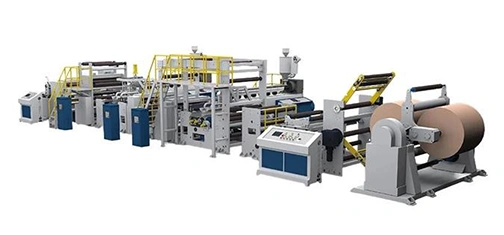
The line reads as a single sequence: dual-station center unwinding under PLC tension control, automatic cutting and reconnecting, an automatic correction system where an ultrasonic sensor spots displacement and a servo pulls the web back on path, a traction unit, three high-power corona units that raise surface energy for peel strength and later printing, the extrusion unit, a triple roller compounding section, edge trimming, and a dual-station friction winder. None of those stations is exotic on its own. What matters is that each one hands the web to the next without letting alignment drift, because a line running at coating speed has no room for a web that walks sideways between the corona and the nip.
The Three Rollers That Decide How It Looks
Holding ±1°C Across the Roller Face
The compounding unit runs large-diameter rollers with a dual-layer flow channel design, and the specification worth circling is ±1°C temperature uniformity across the roller face. That reads like a small number until you see what a warm patch does: the coating sets at a different rate in the middle than at the edge, and the difference comes off the winder as a gloss band on a finished roll that nothing downstream can argue with.
Silicone Rolls and Back Pressure
Rapid setting and cooling come from non-stick silicone rollers working with back-pressure rollers. Silicone keeps the melt from grabbing the roller surface, and back pressure holds the substrate flat against it through the nip — which is how a thin extruded curtain becomes an even coating instead of one that's heavy in the center and light at the edges.
A Screw, a Static Mixer, and a T-Die
Where the Melt Loses Its Memory
The extruder runs a screw built on imported U.S. technology plus a proprietary static mixing unit, and that mixing section does the quiet work: it evens out temperature and flow history so the melt reaches the T-die without streaks carried over from the screw flights. From the die, the curtain drops into the nip with stable flow and edges that stay intact rather than splitting — the failure that forces an operator to trim away the first centimeters of every roll.
Two Models, Three Numbers
Width, Output, and Speed in One View
Two frames cover the range: JDLM1300/110X2C at 600-1200mm coating width, and JDLM1700/110X2C at 900-1600mm. Both carry a 370kg/h maximum extrusion rate and a 270 m/min design line speed, with coating speed between 180-240m/min depending on material and process.
Then the figures that decide whether it fits your building. Main motors are 55kW × 2, total power lands near 260kW on the narrower frame and 290kW on the wider one, and the machine weighs roughly 50t — which is a crane question, not a forklift question. The footprint runs 21 meters long and 11 or 12 meters wide depending on model, on a 380/3/4/50 supply. If your floor was laid out for a 15-meter line, that conversation belongs before the purchase order.
| Item | JDLM1300/110X2C | JDLM1700/110X2C |
|---|---|---|
| Coating width | 600-1200 mm | 900-1600 mm |
| Base material | Paper 40-120 g/m², non-woven, woven | Same |
| Design line speed | 270 m/min | 270 m/min |
| Coating speed | 180-240 m/min | 180-240 m/min |
| Max extrusion | 370 kg/h | 370 kg/h |
| Main motor | 55 kW × 2 | 55 kW × 2 |
| Total power | ≈260 kW | ≈290 kW |
| Unwind diameter | ≤ φ1100 mm | ≤ φ1100 mm |
| Wind diameter | ≤ φ1200 mm | ≤ φ1200 mm |
| Weight | ≈50 t | ≈50 t |
| Dimensions | 21000×11000×3500 mm | 21000×12000×3500 mm |
| Power supply | 380/3/4/50 | 380/3/4/50 |
What LONGGE Puts Behind the Roll
A Winder That Doesn't Need Someone Standing There
LONGGE's GIII Turret Tandem Extrusion Lamination Machine finishes with a dual-station friction winder under PLC control, with servo-driven cutting and roll switching plus automatic shaft loading and unloading — the difference between a line that needs an operator parked at the winder and one that runs unmanned through a shift. A Lamination Machine built this way also carries the smaller stations that keep a run honest: three corona units for peel strength, edge trimming before the roll is wound, and an ultrasonic correction system that catches drift early instead of letting it compound station after station.
What this line is built to coat:
- Pharmaceutical film and food packaging film.
- Printing and office packaging.
- Engineering and construction packaging, including roofing waterproofing membranes.
- Low-GSM paper as the primary target, with other size models custom-made on request.
Send the Substrate, Not Just the Spec
Coating Weight and Line Speed Decide the Build
Two numbers shape most of the answer: the coating weight you need per square meter and the speed you want to hold on your heaviest stock. Bring those along with your substrate and width, and choosing between the two frames stops being a guess. Skip them, and every quotation turns into a range wide enough to be useless.
Send the details through our request a quotation form and we'll come back with a Lamination Machine configuration matched to your substrate, your coating weight, and the footprint your building can actually take.