Does a Printing Machine Need Sleeve Changeover?
Table of Contents
Yes—when the press has to run multiple repeat lengths without a mechanical rebuild. A Printing Machine with sleeve-type plate cylinders lets the operator slide a new sleeve onto the mandrel and run a different job in minutes, instead of swapping gears or replacing the entire plate cylinder. This article explains how the sleeve system eliminates gear-pitch constraints, what the fully servo-driven architecture contributes to repeat flexibility, and what to verify when you're matching a sleeve-type press to a packaging or label line.
How Does a Sleeve-Type Cylinder Work?
Mandrel, Air Chuck, and Removable Sleeve
A sleeve-type plate cylinder is built from three parts: a fixed mandrel that connects to the drive, an air-expandable chuck that grips the sleeve, and the sleeve itself—a thin-walled cylinder that carries the printing plate. The sleeve slides onto the mandrel when the air chuck is deflated, and locks in place when the chuck is inflated.
That arrangement separates the drive component from the printing component. The mandrel stays on the press; only the sleeve changes. A converter running three repeat lengths in a shift keeps three sleeves on the shelf, pre-mounted with their plates, and swaps them as the jobs come up.
No Gear Change for a New Repeat
On a conventional gear-driven press, each repeat length requires a different gear pitch. Changing from a 400mm repeat to a 600mm repeat means changing the gears on every print station. The sleeve system eliminates that step: the servo drive controls the cylinder rotation electronically, so the repeat length is set through the control system, not through a mechanical gear set.
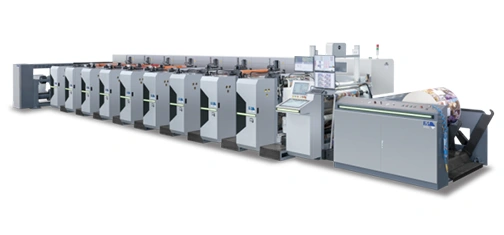
The FM-TS series is fully servo-driven, which removes the gear-pitch constraint entirely. The repeat range is 350–1100mm, and any length within that window can be dialed in without a mechanical change.
| Parameter | FM-TS-650-1450 |
|---|---|
| Max. web width | 870 / 1020 / 1270 / 1370 mm |
| Max. printing width | 850 / 1000 / 1250 / 1350 mm |
| Printing repeat | 350–1100 mm |
| Max. speed | 300 m/min |
| Registration accuracy | ±0.1 mm (constant speed) |
| Substrate weight | 80–350 gsm |
| Drying mode | Hot air / IR / UV LED |
| Ink compatibility | Water-based / UV |
| Plate thickness | 1.7 mm |
| Power | 380V 3PH 50Hz |
Why Does Gearless Drive Matter for Repeat Flexibility?
Electronic Registration Instead of Mechanical Pitch
A gearless press uses independent servo motors on each print station. The registration between stations is maintained electronically, not by a gear train that locks every cylinder to the same pitch. That electronic registration is what allows a sleeve press to run different repeat lengths without changing gears.
The FM-TS holds ±0.1mm registration accuracy at constant speed and ±0.12mm during acceleration and deceleration. The digital pre-registration and plate registration functions reduce manual intervention and increase the finished product yield rate. The press also integrates a full-inspection system that monitors print quality inline.
Sleeve Changeover Time
The practical benefit of the sleeve system is measured in changeover time. A conventional plate cylinder change can take the press down for an extended period while the cylinder is removed, re-plated, and re-installed. A sleeve change is a matter of minutes: deflate the chuck, slide the old sleeve off, slide the new sleeve on, inflate the chuck, and resume production.
That time saving compounds across a high-mix order book. A converter running short runs of multiple SKUs spends less time on changeover and more time printing.
Which Substrates and Inks Does the Press Handle?
Paper, Film, and Foil
The FM-TS series handles art paper, 80–350gsm paper, aluminum foil paper, BOPP, PET, cardstock, kraft paper, coated paper, and PE-coated paper. That substrate range covers flexible packaging, labels, and paper-based secondary packaging.
The press is compatible with both water-based and UV inks, and the drying system can be configured for hot air, infrared, or UV LED drying. A converter running food packaging that requires water-based inks can use the same press for a UV-cured label job by switching the ink and the drying mode.
Plate and Adhesive Thickness
The plate thickness is 1.7mm, and the self-adhesive thickness is 0.38mm or 0.5mm. Those dimensions match the standard photopolymer plates and mounting tapes used in flexographic printing, so the press doesn't require a proprietary plate supply.
Where Does a Sleeve-Type Press Fit in Production?
A Printing Machine with sleeve changeover is used in flexible packaging, label printing, paper bag production, and carton pre-printing where the order mix includes multiple repeat lengths. The 350–1100mm repeat range covers the common packaging formats, and the 300 m/min maximum speed matches the output of a mid-to-high-volume converting line.
The FM-TS series from Longge is built around the sleeve architecture, with the fully servo-driven print stations, the digital registration system, and the inline full-inspection function. The monolithic cast alloy wall panel provides the structural rigidity that holds registration at ±0.1mm across the speed range.
What Should You Check Before Selecting a Sleeve Press?
How do I match the web width to my jobs?
The FM-TS series offers web widths of 870mm, 1020mm, 1270mm, and 1370mm, with printing widths of 850mm, 1000mm, 1250mm, and 1350mm. Match the width to your widest substrate roll plus the edge trim allowance. A 1370mm press running a 1020mm web leaves capacity unused; a 1020mm press at the top of its range leaves no margin for trim or web wander.
What repeat range do I need?
The standard repeat range is 350–1100mm. Measure your smallest and largest design repeat against that window. A sleeve press covers the full range without gear changes, but sleeves are still sized to a specific repeat. The operator needs a sleeve for each repeat length, pre-mounted and ready for changeover.
What maintenance does the sleeve and chuck system need?
Inspect the air chuck for smooth inflation and deflation. A chuck that doesn't grip evenly allows the sleeve to slip, and the registration drifts. Check the sleeve surface for dents or wear—a damaged sleeve transfers a repeating defect to every print. Clean the mandrel and the sleeve bore before mounting to prevent debris from affecting the fit.
Straight Answers on Sleeve-Type Presses
What's the difference between a sleeve cylinder and a conventional plate cylinder?
A conventional plate cylinder is a single unit that includes the shaft, the cylinder body, and the plate mounting surface. Changing the repeat means changing the entire cylinder. A sleeve cylinder separates the mandrel from the sleeve: the mandrel stays on the press, and only the thin sleeve changes.
Can the press run without sleeves?
No. The sleeve is the printing surface. Without a sleeve on the mandrel, there's no plate to transfer ink to the substrate. The sleeve is a consumable that must be matched to the repeat length and the print job.
Does the gearless drive affect print quality?
The gearless servo drive eliminates the gear-pitch constraints and the mechanical wear that a gear train introduces. The registration is maintained electronically, so the print quality stays consistent across different repeat lengths. The FM-TS holds ±0.1mm accuracy at constant speed.
What ink types work on the press?
The press accepts water-based and UV inks. The drying system is configured for hot air, infrared, or UV LED, depending on the ink type. A converter can run both ink types on the same press by switching the ink and adjusting the drying parameters.
Let's Match a Sleeve Press to Your Order Book
Share Your Repeat Range, Web Width, and Ink Type
A Printing Machine with sleeve-type cylinders should match your repeat range, web width, and ink requirements—not the other way around. The Flexographic Printing Press (Sleeve Type) FM-TS-650-1450 from Longge runs at 300 m/min with ±0.1mm registration across 350–1100mm repeats, handles web widths from 870mm to 1370mm, and accepts water-based or UV inks on 80–350gsm paper, film, and foil substrates. If you're specifying a press for high-mix packaging or label production, send us your repeat range, web width, and ink type — we'll help you confirm the right model and sleeve configuration before you order.